
Vitamin E Deficiency in Crohn's Disease: A Patient Guide

This article is for informational purposes only and does not constitute medical advice. Always consult your healthcare provider before making any changes to your treatment plan.
If you have Crohn's disease, your body may be quietly running low on one of its most important antioxidant shields. Vitamin E deficiency in Crohn's disease is driven by a fundamental mismatch: this fat-soluble vitamin requires dietary fat and a healthy small intestine for absorption - exactly the two things Crohn's disrupts. A 2021 study found that 100% of Crohn's patients studied had inadequate dietary vitamin E intake (6), and while biochemical deficiency rates vary across research, the underlying mechanisms clearly put anyone with Crohn's at elevated risk. This guide walks through why vitamin E matters for your gut, how to test for it, and what to do if your levels are low.
Key Takeaways
- 100% of Crohn's patients in a 2021 study had inadequate dietary vitamin E intake, versus 96% of healthy controls (6)
- Biochemical vitamin E deficiency in Crohn's ranges from 2% to 45% across studies, depending on disease activity and measurement method (2)
- Normal serum alpha-tocopherol in adults is greater than 5 mcg/mL; a lipid-corrected ratio gives a more accurate picture during flares (3)
- In a randomized controlled trial, 4 weeks of vitamin E plus vitamin C significantly reduced oxidative stress markers in 57 Crohn's patients (1)
- Water-soluble vitamin E forms (TPGS) exist for patients with severe fat malabsorption who cannot absorb standard softgels (3, 5)
- High-dose vitamin E can increase bleeding risk - always confirm deficiency with blood work before supplementing (5)

Why Vitamin E Matters in Crohn's Disease
Vitamin E (alpha-tocopherol) is your body's primary fat-soluble antioxidant, stationed in cell membranes where it intercepts free radicals before they can cause damage. For those of us living with Crohn's, this matters more than it does for most people - and for reasons that go beyond general "antioxidant" claims.
Crohn's disease generates chronic oxidative stress in the gut, even during periods of clinical remission (4). Inflammatory cells release reactive oxygen species as part of the immune response, and these molecules damage the intestinal lining over time. Vitamin E helps counteract this process by neutralizing lipid peroxidation - essentially preventing the chain-reaction destruction of cell membranes that inflammation sets off.
Beyond its antioxidant role, mechanistic studies suggest that vitamin E supports intestinal barrier integrity by upregulating tight-junction proteins like occludin and ZO-1 (4). These proteins are the molecular glue that holds your intestinal lining together. When tight junctions weaken, bacteria and food particles can slip through the barrier and trigger further inflammation - a process often called "leaky gut" in patient communities. Vitamin E appears to help keep that barrier tighter.
The problem is that unlike water-soluble vitamins (such as folate or vitamin C), vitamin E requires dietary fat and an intact small intestine for absorption. Fat must first be broken down by bile salts and pancreatic enzymes, then vitamin E hitches a ride with the resulting fat droplets across the intestinal wall. Crohn's disease disrupts nearly every step of this process - through intestinal inflammation, surgical removal of bowel segments, bile salt depletion, and chronic diarrhea that rushes nutrients through before they can be absorbed. As we covered in our guide to micronutrient deficiencies in Crohn's disease, fat-soluble vitamins as a group are particularly vulnerable in IBD.
How Common Is Vitamin E Deficiency in Crohn's?
The honest answer is that the true prevalence is unsettled - but the risk is real. Research consistently shows that Crohn's patients fall short on vitamin E, though exactly how many depends on what you measure and how you measure it.
Dietary intake vs. blood levels - two different problems
There is an important distinction between not eating enough vitamin E and having genuinely low blood levels. A 2021 study by Prieto et al. found that 100% of their Crohn's disease cohort had inadequate dietary vitamin E intake, compared with 96% of healthy controls (6). That means almost nobody gets enough vitamin E from food alone - but Crohn's patients absorb less of what little they do eat.
When researchers measure blood levels instead of dietary intake, the numbers shift significantly. A 2023 systematic review by McDonnell et al. found that biochemical vitamin E deficiency prevalence ranged from 2% (in patients in remission, after correcting for cholesterol levels) to 45% (in studies with mixed disease activity and no lipid correction) (2). This wide range reflects differences in study design, not contradictory evidence - the underlying mechanisms of malabsorption and increased oxidative demand are well established.
Who is most at risk
Not every Crohn's patient faces equal risk. Your chances of vitamin E deficiency are highest if you have extensive small-bowel involvement (especially the ileum, where fat absorption happens), a history of ileal resection, short bowel syndrome, chronic diarrhea, or coexisting pancreatic insufficiency. If you recognize yourself in that list, a conversation with your gastroenterologist about fat-soluble vitamin testing is worthwhile. As we explored in our vitamin A deficiency guide, the same malabsorption pathways that deplete vitamin A tend to deplete vitamin E - the two often travel together.
Symptoms and Health Consequences of Low Vitamin E
Vitamin E deficiency develops slowly, and the symptoms can be subtle enough to miss entirely - especially when they overlap with the everyday fatigue and discomfort of living with Crohn's. But when deficiency becomes severe, the consequences are serious.
Neurological signs (the classic deficiency picture)
The hallmark of vitamin E deficiency is neurological damage, because vitamin E protects the lipid-rich membranes of nerve cells. The symptoms progress in a recognizable pattern (3):
- Early signs: hyporeflexia (reduced reflexes), decreased night vision, and loss of vibratory sense - the ability to feel a vibrating tuning fork placed on your ankle or wrist
- Moderate deficiency: ataxia (an unsteady, wide-based gait), muscle weakness, and limited upward gaze. Ataxia is the single most common clinical finding in vitamin E deficiency
- Severe and prolonged deficiency: cardiac arrhythmias, progressive vision loss, and reduced cognition
These neurological changes can be irreversible if deficiency persists for years without treatment. The good news is that early and moderate symptoms typically improve with appropriate supplementation.
Less obvious effects
Before neurological symptoms appear, chronic subclinical vitamin E deficiency may quietly worsen the background oxidative stress that is already elevated in Crohn's disease (4). You will not feel this happening, but it means your body's defenses against inflammation-driven tissue damage are operating below capacity. This is one reason why proactive testing matters - waiting for symptoms means waiting for damage.
Testing: How Vitamin E Status Is Measured
If you suspect low vitamin E, blood testing is the only way to know for certain. Self-supplementing based on symptoms alone is not recommended, because high-dose vitamin E carries its own risks.
The standard test is a serum alpha-tocopherol level. In adults, levels should be greater than 5 mcg/mL (3). Most labs will run this as part of a fat-soluble vitamin panel if your doctor orders it.
Here is the nuance that matters for Crohn's patients: alpha-tocopherol circulates in the blood bound to lipoproteins - the same particles that carry cholesterol. During Crohn's flares, lipid levels often fluctuate, which can falsely inflate or deflate your raw vitamin E number. A patient with temporarily low cholesterol during a flare might look vitamin E-sufficient on paper when they are actually deficient at the cellular level.
For this reason, doctors who specialize in nutritional assessment use the alpha-tocopherol-to-lipid ratio. The threshold is greater than 0.8 mg per gram of total lipids (3). This corrected ratio strips out the confounding effect of cholesterol swings and gives a more reliable picture. If your lab result seems inconsistent with how you feel, ask your care team whether the lipid-corrected ratio was calculated.
When to ask about testing: consider requesting a fat-soluble vitamin panel (vitamins A, D, E, and K) if you have small-bowel Crohn's, a history of ileal resection, ongoing diarrhea, significant unintentional weight loss, or unexplained neurological symptoms like numbness, unsteady gait, or vision changes. Our vitamin K deficiency guide covers why testing these vitamins together makes clinical sense - they share the same absorption pathways.
Food Sources of Vitamin E and Practical IBD Tips
Even if you need supplementation, building dietary vitamin E into your meals creates a more stable baseline. The adult RDA is 15 mg per day, and many adults fall short even without IBD (5).
Top food sources
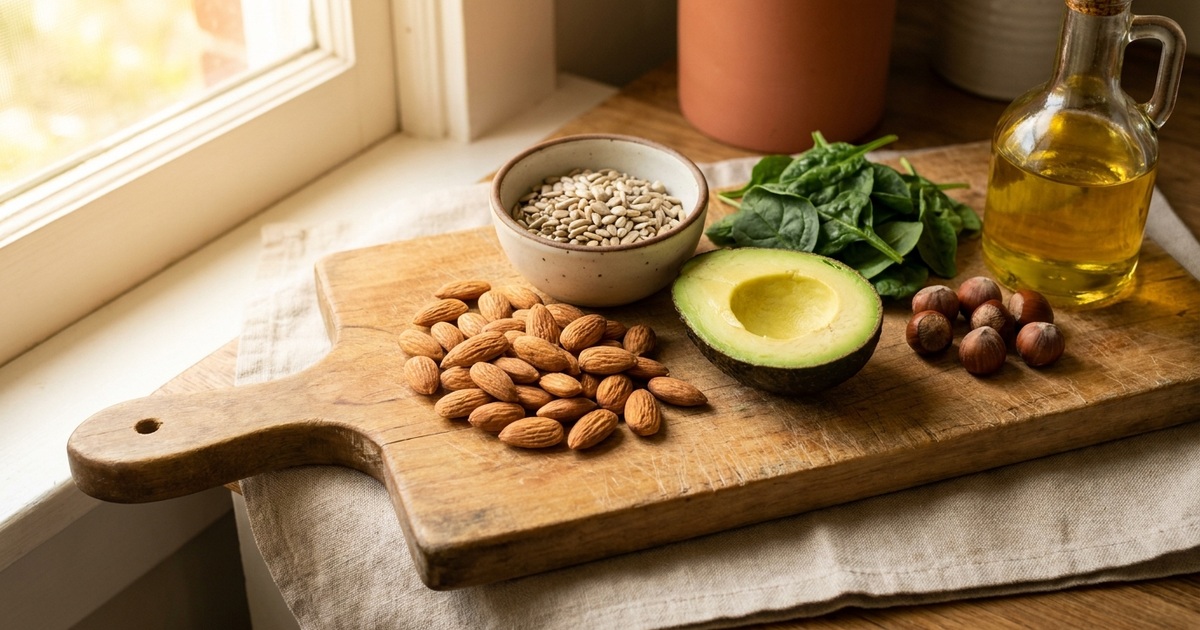
The richest natural sources of vitamin E, with approximate amounts per serving (5):
- Sunflower seeds - 7.4 mg per 1 oz (about half the daily RDA)
- Almonds - 7.3 mg per 1 oz
- Sunflower oil and safflower oil - 5.6 mg per tablespoon
- Hazelnuts - 4.3 mg per 1 oz
- Wheat germ - 3.4 mg per 2 tablespoons
- Spinach (cooked) - 3.7 mg per cup
- Avocado - 2.7 mg per half
- Red bell peppers - 1.9 mg per medium pepper
Tolerability with Crohn's
Many of the best vitamin E sources - nuts, seeds, raw spinach - are exactly the foods that Crohn's patients are told to avoid during flares. Here are practical workarounds:
- Nut butters (smooth almond butter, sunflower seed butter) deliver the vitamin E of whole nuts without the rough texture and fiber that can irritate inflamed bowels
- Oils added to cooked vegetables - drizzle sunflower or safflower oil over steamed carrots, mashed sweet potato, or pureed squash for a gentle vitamin E boost
- Pureed avocado blended into smoothies or spread on soft bread is usually well tolerated even during mild flares
- Pair vitamin E foods with some dietary fat at the same meal - since vitamin E is fat-soluble, eating it alongside a fat source improves absorption significantly
As we discussed in our dietary supplements and IBD overview, food-first strategies provide a foundation, but supplementation is sometimes necessary when malabsorption outpaces what diet alone can deliver.
Supplementation: What the Evidence Shows
The strongest evidence for vitamin E supplementation in Crohn's comes from a 2003 randomized controlled trial by Aghdassi et al. published in the American Journal of Gastroenterology. The study gave 57 Crohn's patients 800 IU of vitamin E plus 1000 mg of vitamin C daily for 4 weeks (1). The results were clear: oxidative stress markers - including breath pentane, F2-isoprostanes, and lipid peroxides - decreased significantly, while disease activity remained stable. This suggests that antioxidant supplementation can reduce the oxidative burden in Crohn's without disrupting disease management.
Standard oral supplements and the water-soluble option
Most over-the-counter vitamin E comes as alpha-tocopherol softgels, which rely on the same fat-absorption pathway that Crohn's disease disrupts. For patients with mild-to-moderate disease, standard softgels taken with a fat-containing meal are often sufficient.
But for patients with severe fat malabsorption - those with extensive ileal disease, short bowel syndrome, or ongoing steatorrhea - standard vitamin E may pass through largely unabsorbed. In these cases, the NIH and clinical references note that water-soluble forms of vitamin E, specifically tocopheryl polyethylene glycol-1000 succinate (TPGS), can bypass the fat-absorption requirement and deliver vitamin E more reliably (3, 5). TPGS is not available in every pharmacy, but your gastroenterologist or pharmacist can help you source it.
The adult RDA for vitamin E is 15 mg per day, and the tolerable upper limit from supplements is 1000 mg per day of alpha-tocopherol (5). Most clinical scenarios in Crohn's fall well within that range.
Red flags that warrant a clinician conversation
- Any new neurological symptom - ataxia, numbness or tingling, vision changes, or loss of reflexes - in a Crohn's patient warrants prompt evaluation, not the next routine visit. These may reflect vitamin E deficiency, B12 deficiency, or other causes that need timely diagnosis
- High-dose vitamin E can increase bleeding risk, especially if you take anticoagulants, aspirin, or NSAIDs. Discuss any dose above 100 to 200 IU with your medical team before starting
- After ileal resection, prolonged active disease, chronic diarrhea, or significant unintentional weight loss, bring up fat-soluble vitamin testing proactively rather than waiting for symptoms
- Do not self-supplement based on symptoms alone - confirm deficiency with blood work first, because excess vitamin E is stored in fat tissue and high doses carry real risks
Frequently Asked Questions
Is vitamin E deficiency common in Crohn's disease?
Dietary inadequacy is extremely common - a 2021 study found 100% of Crohn's patients had inadequate vitamin E intake (6). Biochemical blood-level deficiency varies more widely, from 2% to 45% depending on disease activity and how levels are measured (2). The underlying malabsorption mechanisms make Crohn's patients consistently higher risk than the general population.
What are the symptoms of low vitamin E?
Early symptoms include reduced reflexes, decreased night vision, and loss of vibratory sense. As deficiency progresses, ataxia (unsteady gait), muscle weakness, and limited upward gaze can develop. Severe, prolonged deficiency may cause cardiac arrhythmias and vision loss (3). Many early signs overlap with everyday Crohn's fatigue, making blood testing essential.
How is vitamin E tested?
The standard test measures serum alpha-tocopherol, with levels above 5 mcg/mL considered normal in adults (3). For Crohn's patients with fluctuating cholesterol levels, especially during flares, the alpha-tocopherol-to-lipid ratio (above 0.8 mg/g) provides a more accurate reading. Ask your doctor about a full fat-soluble vitamin panel if you have small-bowel involvement.
Can I get enough vitamin E from food alone?
It is possible but challenging, even without Crohn's. One ounce of sunflower seeds (7.4 mg) or almonds (7.3 mg) provides roughly half the daily RDA of 15 mg (5). Crohn's patients may struggle with nut and seed tolerability during flares, so nut butters, oils, and pureed avocado are gentler alternatives. If malabsorption is significant, dietary sources alone may not be sufficient.
Is vitamin E supplementation safe for Crohn's patients?
For most Crohn's patients with confirmed deficiency, supplementation within recommended ranges is considered safe. A randomized controlled trial using 800 IU of vitamin E daily for 4 weeks showed reduced oxidative stress with no adverse effects on disease activity (1). However, high-dose vitamin E can increase bleeding risk, so any dose above 100 to 200 IU should be discussed with your medical team, especially if you take blood thinners.
What is TPGS and when is it needed?
TPGS (tocopheryl polyethylene glycol-1000 succinate) is a water-soluble form of vitamin E designed for patients with severe fat malabsorption who cannot adequately absorb standard vitamin E softgels (3, 5). It may be recommended for patients with extensive ileal disease, short bowel syndrome, or chronic steatorrhea. Your gastroenterologist or pharmacist can help source it.
Should I take vitamin E with other fat-soluble vitamins?
Fat-soluble vitamins A, D, E, and K share absorption pathways, and Crohn's patients often run low on more than one simultaneously. Testing and addressing them together makes clinical sense. However, vitamin E at high doses can interfere with vitamin K metabolism and increase bleeding risk, so balanced supplementation guided by blood work is safer than taking individual high-dose vitamins on your own.
References
- Aghdassi E, Wendland BE, Steinhart AH, Wolman SL, Jeejeebhoy K, Allard JP. Antioxidant vitamin supplementation in Crohn's disease decreases oxidative stress: a randomized controlled trial. American Journal of Gastroenterology, 2003. Read study
- McDonnell M, Sartain S, Westoby C, Katarachia V, Wootton SA, Cummings JRF. Micronutrient Status in Adult Crohn's Disease during Clinical Remission: A Systematic Review. Nutrients, 2023. Read study
- Kemnic TR, Coleman M. Vitamin E Deficiency. StatPearls, NCBI Bookshelf, updated 2023. Read article
- Wu Q, Luo Y, Lu H, Xie T, Hu Z, Chu Z, Luo F. The Potential Role of Vitamin E and the Mechanism in the Prevention and Treatment of Inflammatory Bowel Disease. Foods, 2024. Read study
- NIH Office of Dietary Supplements. Vitamin E - Health Professional Fact Sheet. 2024. Read article
- Prieto JMI, Andrade AR, Magro DO, et al. Nutritional Global Status and Its Impact in Crohn's Disease. Journal of the Canadian Association of Gastroenterology, 2021. Read study
Recommended Resources
Browse ResourcesRelated Articles

Vitamin B6 Deficiency in Crohn's Disease: A Patient Guide
Vitamin B6 deficiency affects many Crohn's patients, linked to thrombosis, fatigue, and neuropathy. Learn causes, testing, and evidence-based treatment now.

Vitamin C Deficiency in Crohn's Disease: A Patient Guide
Vitamin C deficiency affects up to 24% of Crohn's disease patients. Learn the causes, scurvy symptoms, blood tests, safe foods, and evidence-based doses.

Vitamin A Deficiency in Crohn's Disease: A Patient Guide
Vitamin A deficiency in Crohn's disease can cause night blindness and skin problems. Learn evidence-based symptoms, testing, and supplementation guidance.

Vitamin K Deficiency in Crohn's Disease: A Patient Guide
Vitamin K deficiency affects over half of Crohn's patients and harms bone health. Learn foods, supplements, and lab tests every patient should know about.

Vitamin B12 Deficiency in Crohn's Disease: A Full Guide
Why Crohn's disease with ileal involvement causes B12 deficiency, the symptoms to watch for, why standard blood tests miss it, and the treatment options.

Niacin (Vitamin B3) for Crohn's Disease: A Patient Guide
Niacin (vitamin B3) deficiency is common in Crohn's disease. Learn how malabsorption triggers pellagra, spot early skin signs, and pick safe daily doses.