
Boswellia for Crohn's Disease: What Research Really Shows

This article is for informational purposes only and does not constitute medical advice. Always consult your healthcare provider before making any changes to your treatment plan.
If you have been researching natural supplements for Crohn's disease, chances are you have come across Boswellia serrata - the ancient Ayurvedic resin sometimes called Indian frankincense. Online supplement stores are full of bold claims, but what does the actual clinical evidence say? In this guide, we walk through the randomized trials, the safety data, and the drug interactions that most articles skip, so you can have an informed conversation with your gastroenterologist about whether Boswellia for Crohn's disease deserves a place in your care plan.
Key Takeaways
- In a 2001 randomized trial, Boswellia extract H15 reduced Crohn's Disease Activity Index scores by 90 points - comparable to mesalazine - but the sample was small (1).
- A larger 2011 placebo-controlled maintenance trial found no benefit: Boswellia and placebo had nearly identical remission rates, and the trial was terminated early (2).
- Positive results in ulcerative colitis and collagenous colitis trials do not automatically transfer to Crohn's disease, which involves different gut layers and mechanisms.
- Boswellic acids inhibit CYP450 enzymes and may interact with warfarin, blood thinners, and many common medications (6).
- The NIH LiverTox database rates Boswellia as unlikely to cause liver injury, and side effects in trials were generally mild and temporary (5).
- Boswellia should be considered an adjunct under medical supervision - never a replacement for prescribed biologics or immunomodulators.
What Is Boswellia Serrata and Why People Try It for Crohn's
Boswellia serrata is a tree native to India, the Middle East, and North Africa. For thousands of years, practitioners of Ayurvedic medicine have used the gum resin tapped from its bark - known as salai guggul or Indian frankincense - to treat inflammatory conditions. Today, that traditional use has sparked serious scientific interest in how the resin's active compounds might affect gut inflammation.
The Plant, the Resin, and Indian Frankincense
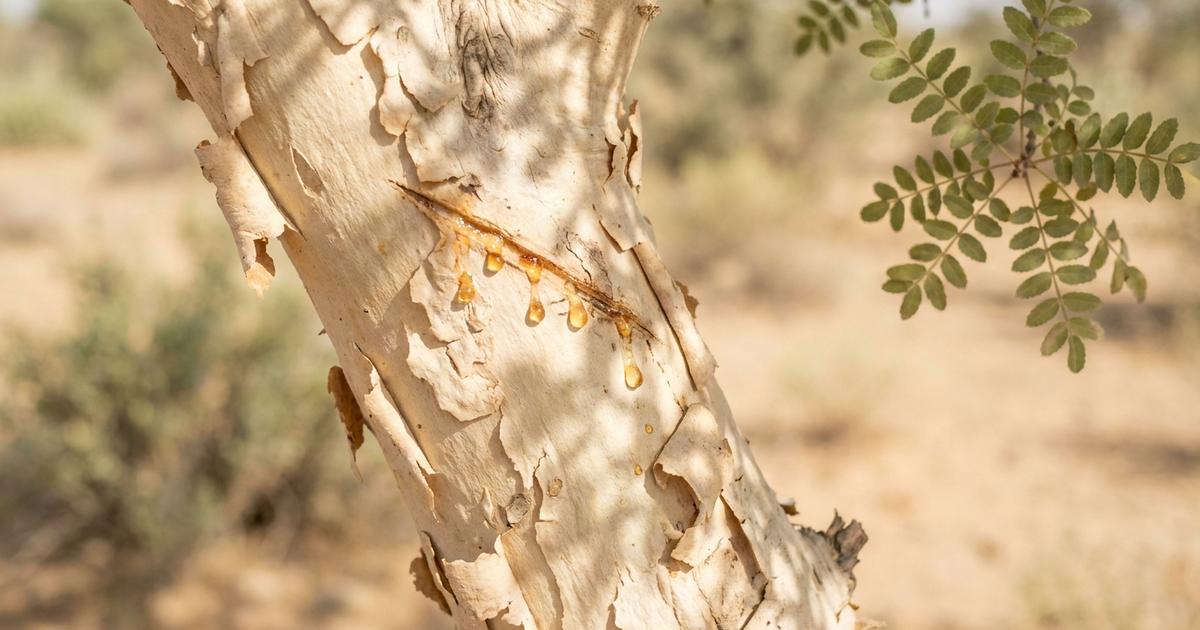
When the bark of the Boswellia serrata tree is scored, it oozes a fragrant, amber-colored resin. This is the same family of resins that gives us the frankincense burned as incense for centuries - but the species used medicinally is specifically Boswellia serrata, not the frankincense species you might find at a gift shop. The resin is dried, processed, and either taken as a whole extract or standardized for its active compounds in capsule form.
Boswellic Acids and the 5-Lipoxygenase Pathway
The active compounds in Boswellia resin are a group of molecules called boswellic acids. Among them, 3-O-acetyl-11-keto-beta-boswellic acid - mercifully abbreviated as AKBA - shows the strongest anti-inflammatory activity (7). AKBA works through a very specific mechanism: it acts as a selective, non-redox, non-competitive inhibitor of 5-lipoxygenase (5-LOX), the enzyme responsible for producing leukotrienes (7). Leukotrienes are pro-inflammatory molecules that play a documented role in IBD, so blocking their production is a plausible reason this ancient resin attracted the attention of gastroenterology researchers.
Before we go further, a critical point: Boswellia is a supplement being studied as an adjunct therapy. It has not been proven to replace any prescribed Crohn's treatment. If you are curious about the broader landscape of supplements studied in IBD, our overview of dietary supplements and IBD provides helpful context.
The Evidence for Boswellia in Active Crohn's Disease
The most commonly cited evidence for Boswellia in Crohn's comes from a single small randomized trial conducted in Germany. It is the study that supplement companies point to most often - and understanding its real findings is essential for making an informed decision.
The Gerhardt H15 Trial vs Mesalazine (2001)
In 2001, Gerhardt and colleagues published a randomized, double-blind trial in the journal Zeitschrift fur Gastroenterologie comparing Boswellia serrata extract H15 to mesalazine (also known as mesalamine or 5-ASA) in patients with active Crohn's disease (1). In the per-protocol population, 44 patients received H15 and 39 received mesalazine. The Crohn's Disease Activity Index (CDAI) dropped by a mean of 90 points in the Boswellia group compared to 53 points in the mesalazine group (1).
The authors concluded that H15 was not inferior to mesalazine. However, the difference favoring Boswellia was not statistically significant for the primary endpoint (1).
How to Read a Small Non-Inferiority Trial
For those of us trying to make decisions from these numbers, some context matters enormously. First, this was a small trial - fewer than 50 patients per arm - which limits statistical power. Second, and more importantly, mesalazine itself has limited proven benefit in Crohn's disease. Many gastroenterologists today consider mesalazine a relatively weak treatment for Crohn's. So a "non-inferiority" result against mesalazine is a modest signal - it tells us Boswellia might do as well as a comparator that itself does not do very well in Crohn's. It is very different from, say, matching the efficacy of a biologic like infliximab or ustekinumab.
The Evidence for Boswellia in Maintaining Crohn's Remission
While the Gerhardt trial looked at active disease, a larger and more rigorous trial tested whether Boswellia could help keep Crohn's in remission over a longer period. This trial receives far less attention in the supplement world, but it is arguably the more important study.
The 2011 Boswelan Maintenance Trial
Holtmeier and colleagues conducted a multicenter, randomized, placebo-controlled, double-blind trial in Germany, published in Inflammatory Bowel Diseases in 2011 (2). They tested Boswelan - a purified Boswellia serrata extract - for maintaining remission in Crohn's disease. A total of 82 patients were randomized.
The results were clear: 59.9 percent of patients on Boswelan stayed in remission compared to 55.3 percent on placebo, a difference that was nowhere close to statistical significance (p=0.85) (2).

What Negative and Terminated Trials Mean
The trial was terminated early because the extract and placebo were performing too similarly on the primary endpoint (2). In clinical research, early termination for futility is a strong signal - it means that even if the trial had continued enrolling patients, the likelihood of finding a meaningful difference was essentially zero.
For patients, this means the best available evidence does not support Boswellia serrata as a proven maintenance therapy for Crohn's disease. This does not mean the supplement is harmful or that it has zero biological activity - only that it did not outperform sugar pills at keeping Crohn's in remission over a year-long study.
Related Evidence in Ulcerative Colitis and Collagenous Colitis
Some of the more encouraging Boswellia data comes from trials in other forms of inflammatory bowel disease. Understanding why those results do not automatically apply to Crohn's is important for setting realistic expectations.
Gupta 1997 in Ulcerative Colitis
In 1997, Gupta and colleagues published a study in the European Journal of Medical Research comparing Boswellia gum resin (350 mg three times daily) to sulfasalazine in 42 patients with grade II to III ulcerative colitis over 6 weeks (3). Remission was reported in 82 percent of Boswellia patients compared to 75 percent of sulfasalazine patients (3).
These numbers sound impressive, but there are important limitations. The trial was open-label (patients and doctors knew who received what), which can inflate reported benefits. It was small - just 42 patients. And 18 percent of the Boswellia group reported gastrointestinal side effects such as heartburn, nausea, or abdominal pain (3).
Madisch 2007 in Collagenous Colitis
A more rigorous study came from Madisch and colleagues in 2007, published in the International Journal of Colorectal Disease (4). This randomized, double-blind, placebo-controlled trial tested Boswellia serrata extract (400 mg three times daily) in 26 evaluable patients with collagenous colitis. Clinical remission occurred in 63.6 percent of Boswellia patients versus 26.7 percent on placebo - a statistically significant difference (p=0.04) (4).
However, the trial also found no improvement in histology (how the tissue looked under a microscope) and no improvement in quality of life (4). Collagenous colitis is also a different disease from Crohn's, involving different mechanisms and different layers of the bowel wall. So while this result supports continued scientific interest in boswellic acids, it does not confirm benefit in Crohn's disease specifically.
For readers interested in other plant-derived supplements studied in Crohn's, we have explored turmeric and curcumin and ginger in separate guides.
Safety, Side Effects, and Drug Interactions
One area where Boswellia serrata performs well in the research is safety - with one important exception that most supplement blogs overlook entirely.
General Tolerability and Liver Safety
The NIH's LiverTox database - a respected resource for evaluating medication-related liver safety - gives Boswellia serrata a likelihood score of E, meaning it is unlikely to cause clinically apparent liver injury (5). This is reassuring, especially for patients with Crohn's who may already be taking medications that carry liver risks.
In the controlled trials, side effects from Boswellia were generally mild, usually transient, and occurred at rates comparable to placebo (5). The most commonly reported issues were gastrointestinal symptoms - some nausea, occasional heartburn, mild diarrhea or constipation - which many of us living with Crohn's are unfortunately very familiar with already.
CYP450 Interactions and Warfarin Risk
Here is where the safety picture gets more nuanced. Boswellic acids have been shown in laboratory studies to inhibit several CYP450 enzymes - specifically CYP2C8/2C9, CYP2C19, and CYP3A4 (6). These enzymes are responsible for metabolizing a wide range of medications, including many that people with Crohn's may take.
The most concerning documented interaction involves warfarin. Case reports suggest that Boswellia may raise INR levels in patients stabilized on warfarin, increasing bleeding risk (6). If you are taking warfarin or another blood thinner, starting Boswellia without discussing it with your prescribing doctor is strongly discouraged.
Additionally, CYP3A4 is involved in metabolizing some immunosuppressants used in Crohn's disease, including certain biologics and immunomodulators. While clinical interaction studies are limited, the theoretical risk is worth flagging with your healthcare team.
Pregnancy and breastfeeding safety data for Boswellia are not established. If you are pregnant, planning a pregnancy, or breastfeeding, it is best to avoid Boswellia unless your clinician specifically advises otherwise.
Practical Considerations if You and Your Doctor Consider Trying Boswellia
If, after reviewing the evidence, you and your gastroenterologist decide that a trial of Boswellia is reasonable alongside your existing treatment, here is what the research literature can tell us about practical use.
Doses Used in Trials and Product Quality
The published IBD trials used Boswellia serrata extract at doses of 300 to 400 mg three times daily for 6 to 8 weeks in active disease studies (1, 3, 4). However, "300 mg of Boswellia extract" can mean very different things depending on the product. What matters more than total resin milligrams is the standardized boswellic acid content - and specifically the AKBA percentage.
Because dietary supplements are not regulated by the FDA (or most international equivalents) for potency or purity the way prescription medications are, product quality varies enormously. Look for supplements that carry third-party testing certifications such as USP, NSF International, or ConsumerLab, and that list the standardized boswellic acid or AKBA content on the label.
Questions to Ask Your Gastroenterologist
Before starting Boswellia or any supplement, consider raising these points with your doctor:
- Current medications and CYP450 overlap - Are any of your medications metabolized by CYP2C8/2C9, CYP2C19, or CYP3A4?
- Blood thinner use - Are you on warfarin, DOACs (direct oral anticoagulants), or aspirin?
- Upcoming surgery - Is there any procedure planned where bleeding risk matters?
- Pregnancy or family planning - Safety data in pregnancy is lacking.
- Tracking disease objectively - Can you use fecal calprotectin, CRP, or another biomarker to evaluate whether the supplement is actually doing anything?
That last point is especially important. Many of us evaluate supplements by how we feel, which is understandable but can be misleading. If you and your doctor decide to try Boswellia, consider re-evaluating at 8 to 12 weeks using objective markers rather than gut feeling alone.
And the non-negotiable rule: never stop or reduce prescribed biologics, immunomodulators, corticosteroids, or 5-ASA medications without your gastroenterologist's guidance. Boswellia has not been shown to replace any of these. For a broader look at how complementary approaches fit alongside conventional treatment, our complementary therapies guide explores the full landscape.
Frequently Asked Questions
Is Boswellia serrata proven to treat Crohn's disease?
No. One small 2001 trial found Boswellia extract was non-inferior to mesalazine in active Crohn's disease, but the larger 2011 maintenance trial found it was no better than placebo at keeping Crohn's in remission (1, 2). Current evidence is insufficient to call Boswellia a proven Crohn's treatment.
Can I take Boswellia instead of my biologic or immunosuppressant?
Absolutely not. No clinical trial has compared Boswellia to modern biologics or immunomodulators in Crohn's disease. The only comparison trial used mesalazine - a treatment with limited proven benefit in Crohn's. Stopping prescribed therapy in favor of a supplement puts you at risk of flares, complications, and disease progression. Always discuss changes with your gastroenterologist.
What dose of Boswellia was used in the Crohn's disease trials?
The Gerhardt 2001 trial used Boswellia serrata extract H15 at a dose that provided 300 to 400 mg of extract three times daily for 8 weeks (1). Other IBD trials used similar doses. Look for products standardized for boswellic acid or AKBA content, and verified by third-party testing organizations.
Does Boswellia interact with other medications?
Yes. Boswellic acids inhibit CYP450 enzymes including CYP2C8/2C9, CYP2C19, and CYP3A4 in laboratory studies (6). This means Boswellia may interact with warfarin, certain immunosuppressants, and many other medications. Case reports link Boswellia to elevated INR in warfarin users. Discuss potential interactions with your doctor before starting.
Is Boswellia safe for the liver?
The NIH LiverTox database rates Boswellia serrata as category E - unlikely to cause clinically apparent liver injury (5). Side effects in clinical trials were generally mild, transient, and comparable to placebo. However, this good liver safety profile does not eliminate the risk of drug interactions.
Can the positive Boswellia results in ulcerative colitis apply to Crohn's?
Not directly. Ulcerative colitis and collagenous colitis involve different parts and layers of the bowel wall than Crohn's disease. The positive results from the Gupta 1997 ulcerative colitis trial and the Madisch 2007 collagenous colitis trial support scientific interest but cannot be assumed to predict the same benefit in Crohn's (3, 4).
Is Boswellia safe during pregnancy or breastfeeding?
Safety data for Boswellia during pregnancy and breastfeeding are not established. Without clinical evidence of safety in these populations, it is best to avoid Boswellia during pregnancy, while planning pregnancy, or while breastfeeding unless specifically advised by your healthcare provider.
References
- Gerhardt H, Seifert F, Buvari P, Vogelsang H, Repges R. Therapy of active Crohn disease with Boswellia serrata extract H 15. Z Gastroenterol, 2001;39(1):11-17. View on PubMed
- Holtmeier W, Zeuzem S, Preiss J, Kruis W, et al. Randomized, placebo-controlled, double-blind trial of Boswellia serrata in maintaining remission of Crohn's disease: good safety profile but lack of efficacy. Inflammatory Bowel Diseases, 2011;17(2):573-582. View on PubMed
- Gupta I, Parihar A, Malhotra P, Singh GB, Ludtke R, Safayhi H, Ammon HP. Effects of Boswellia serrata gum resin in patients with ulcerative colitis. European Journal of Medical Research, 1997;2(1):37-43. View on PubMed
- Madisch A, Miehlke S, Eichele O, et al. Boswellia serrata extract for the treatment of collagenous colitis. A double-blind, randomized, placebo-controlled, multicenter trial. International Journal of Colorectal Disease, 2007;22(12):1445-1451. View on PubMed
- National Institute of Diabetes and Digestive and Kidney Diseases. Boswellia Serrata. LiverTox: Clinical and Research Information on Drug-Induced Liver Injury. Read on NCBI
- Sen A. Complementary medicines used in ulcerative colitis and unintended interactions with cytochrome P450-dependent drug-metabolizing enzymes. Turkish Journal of Medical Sciences, 2022. Read on PubMed Central
- Siemoneit U, Pergola C, Jazzar B, Northoff H, Skarke C, Jauch J, Werz O. 5-Lipoxygenase inhibition by acetyl-11-keto-beta-boswellic acid (AKBA) by a novel mechanism. 2012. View on PubMed
Recommended Resources
Browse ResourcesRelated Articles

Kefir for Crohn's Disease: What Research Really Shows
Can kefir help Crohn's disease? What human trials and microbiome studies show, how it compares to yogurt, how to try it safely, and when to skip it.

Melatonin for Crohn's Disease: What Research Really Shows
Can melatonin help Crohn's disease? What clinical trials and microbiome research show about the benefits, risks, dosing, and safety for IBD patients today.

Coffee and Crohn's Disease: What Research Really Shows
Coffee and Crohn's disease: does caffeine really trigger flares? See what recent research shows on symptoms, gut microbiome, and safe intake with IBD.

Psyllium Fiber for Crohn's Disease: What Research Shows
Is psyllium safe with Crohn's? What the research shows about soluble fiber, the benefits, correct dosing, and when strictures make it a bad idea.

Mastic Gum for Crohn's Disease: What the Research Shows
Mastic gum for Crohn's disease: what small trials say about CDAI reduction, IL-6, CRP, dosing, side effects, and whether this ancient resin actually helps.

Specific Carbohydrate Diet for Crohn's: What Research Shows
The Specific Carbohydrate Diet (SCD) cuts grains, most sugars, and complex starches. See what the DINE-CD trial shows about SCD for Crohn's disease symptoms.