
Mastic Gum for Crohn's Disease: What the Research Shows

This article is for informational purposes only and does not constitute medical advice. Always consult your healthcare provider before making any changes to your treatment plan.
If you have been browsing supplement forums or IBD communities online, you have probably come across mastic gum - the aromatic tree resin from the Greek island of Chios that has been used for digestive complaints for centuries. But does any real clinical evidence support mastic gum for Crohn's disease, or is this just another supplement with more history than data? In this guide, we walk through the actual clinical trials, the exact doses researchers used, the safety profile, and where mastic gum honestly fits alongside proven Crohn's treatments today.
Key Takeaways
- In the only Crohn's-specific trial, 7 of 10 patients taking 2.2 g/day of Chios mastic capsules for 4 weeks met CDAI remission criteria, with significant drops in IL-6 and CRP (1).
- Later randomized trials in mixed IBD populations (60 to 129 patients) report improvements in quality of life, fecal biomarkers, and serum IL-17A levels (3, 4).
- A 2023 systematic review of 8 studies concluded mastic gum has significant antioxidant and anti-inflammatory effects in IBD, but noted small sample sizes and geographic clustering as limitations (5).
- Doses used across published trials range from 2.2 g/day to 2.8 g/day for 4 weeks to 6 months - there is no established optimal dose for Crohn's specifically.
- The most common side effect is loose stools or diarrhea, especially at higher doses, and data on pregnancy and breastfeeding are limited (6).
- Mastic gum is a potential adjunct being studied, not a proven therapy or a replacement for biologics, immunomodulators, or other prescribed Crohn's treatments.
What Is Mastic Gum and Why People Try It for Crohn's Disease
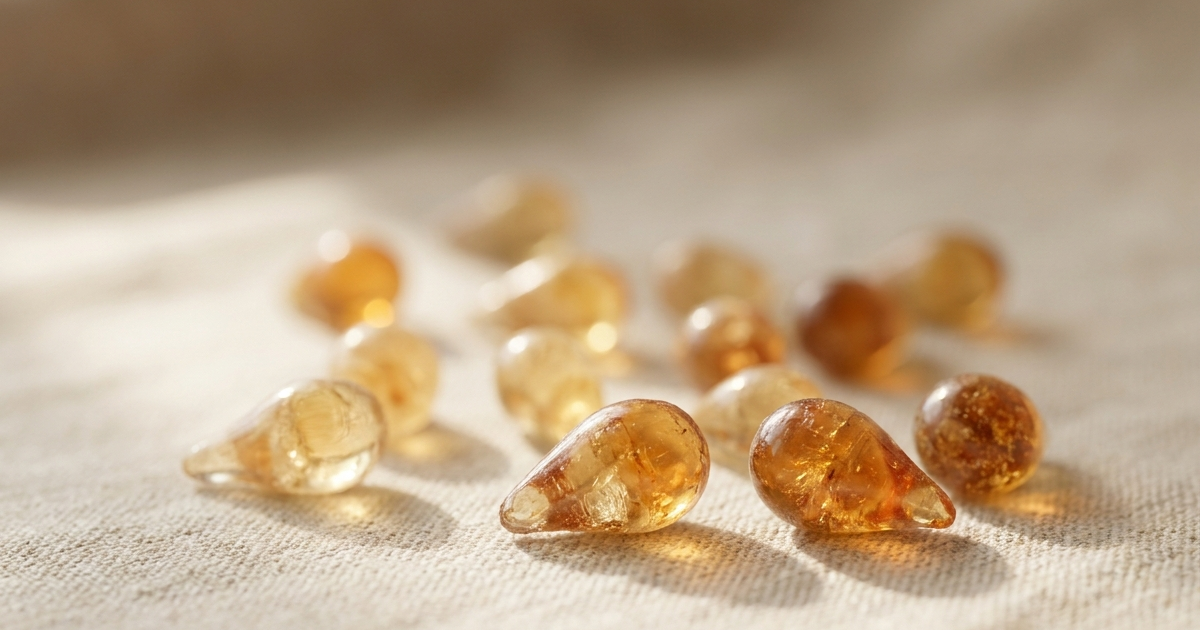
Mastic gum is a natural aromatic resin harvested from the bark of Pistacia lentiscus var. Chia, a small evergreen tree that grows almost exclusively on the southern part of the Greek island of Chios. When the bark is scored, the tree "weeps" droplets of resin that harden into translucent, tear-shaped pieces - which is why raw mastic is often called "Chios tears."
Where Chios Mastic Comes From
Chios has been the center of mastic production for over 2,500 years, and the resin carries a Protected Designation of Origin (PDO) from the European Union. While Pistacia lentiscus grows across the Mediterranean, only the Chios variety produces enough resin to be commercially harvested. This matters for supplement quality: most clinical trials specifically used Chios-origin mastic, and the composition of mastic from other regions may differ.
Historical Uses in Digestive Complaints
Across the Mediterranean and Middle East, mastic gum has been chewed or swallowed for indigestion, stomach ulcers, and oral health for centuries. In the early 2000s, some of the early modern interest came from studies showing mastic gum could inhibit Helicobacter pylori, the bacterium behind many peptic ulcers. That anti-ulcer research opened the door for gastroenterologists to ask whether mastic might also help in inflammatory bowel disease.
Active Compounds Researchers Focus On
Modern research has identified several groups of biologically active molecules in mastic resin. Triterpenes - including oleanolic acid, masticadienonic acid, and isomasticadienonic acid - are the most studied, along with polyphenols and arabino-galactan proteins (2). In laboratory settings, these compounds have demonstrated anti-inflammatory, antioxidant, and antimicrobial activity (2). That consistent lab-based signal is what motivated researchers to test mastic gum in actual patients with Crohn's disease and ulcerative colitis.
If you have been exploring other plant-based supplements with anti-inflammatory research in IBD, our guide to Boswellia serrata for Crohn's disease covers another ancient resin that has been through clinical trials.
What Clinical Trials Show in Crohn's Disease and IBD
The evidence base for mastic gum in IBD is small but growing. A handful of clinical trials - most conducted in Greece - have tested Chios mastic in Crohn's disease, ulcerative colitis, or mixed IBD populations. Here is what each one actually found.
The 2007 Kaliora Pilot Study in Active Crohn's
The only clinical trial conducted exclusively in Crohn's disease patients is the 2007 pilot study by Kaliora and colleagues, published in the World Journal of Gastroenterology (1). Ten patients with mild to moderately active Crohn's disease took 2.2 g/day of Chios mastic capsules for 4 weeks. At the end of the treatment period, the researchers reported significant reductions in the Crohn's Disease Activity Index (CDAI) and in plasma levels of IL-6 and CRP - two inflammatory markers that are elevated during active Crohn's. Seven of the 10 patients met CDAI remission criteria by the end of the study (1).
This is encouraging, but it is critical to read it in context. Ten patients, no placebo arm, and four weeks of follow-up make this a hypothesis-generating pilot, not definitive proof. The study tells us the idea is worth testing in a larger, controlled trial - which has not yet been done in Crohn's patients specifically.
The 2019 Papada Randomized Trial in IBD
Papada and colleagues published a randomized, double-blind, placebo-controlled trial in 2019 in Phytotherapy Research (3). This study enrolled 60 IBD patients - a mix of Crohn's disease and ulcerative colitis - and gave the treatment group 2.8 g/day of mastiha (the Greek term for mastic) for 3 months. The mastiha arm showed a significant decrease in fecal lysozyme, a biomarker of intestinal inflammation, and improved scores on the Inflammatory Bowel Disease Questionnaire (IBDQ), which measures quality of life (3).
The 2021 Amerikanou Trial and the IL-17A Signal
The largest mastic trial in IBD to date is the 2021 study by Amerikanou and colleagues, which enrolled 129 IBD patients (67 mastiha, 62 placebo) and followed them for 3 to 6 months (4). This randomized, double-blind trial reported significant changes in serum IL-17A - a cytokine involved in the Th17 inflammatory pathway that is a major drug target in IBD - and in the fecal metabolome (4). The Th17 pathway is the same pathway targeted by newer biologic medications being developed for Crohn's, so finding that mastic gum modulates IL-17A is a noteworthy signal, even if the clinical implications are not yet clear.
What the 2023 Systematic Review Concluded
In 2023, Mavroudi and colleagues published a systematic review in the Journal of Medicinal Food that identified 8 eligible studies examining Chios mastic supplementation in IBD (5). The review concluded that mastic gum has significant antioxidant and anti-inflammatory effects in IBD populations. However, the authors were careful to note two major limitations: sample sizes across studies remain small, and the research is geographically clustered in Greece, raising questions about generalizability (5).

How Mastic Gum May Reduce Inflammation in the Gut
Understanding the proposed mechanisms helps put the clinical findings in perspective. Mastic gum does not work through a single, clean pathway like a biologic drug - instead, multiple mechanisms have been identified in both lab and human studies.
Effects on IL-6, CRP, and Other Inflammatory Markers
The Kaliora pilot trial reported reductions in plasma IL-6 and CRP, both of which are standard markers that gastroenterologists use to track Crohn's disease activity (1). IL-6 drives the acute-phase inflammatory response, while CRP is a downstream product of that response. Reductions in both suggest the resin is doing something upstream in the inflammatory cascade, though the mechanism has not been fully pinpointed.
Antioxidant Activity and Oxidized LDL
Beyond classical inflammatory markers, mastic gum has measurable antioxidant activity. Studies have documented changes in oxidized LDL and total antioxidant capacity in patients taking mastic supplements (2). While oxidative stress is a recognized contributor to IBD tissue damage, it is worth noting that "antioxidant activity" is one of the most commonly claimed - and least clinically meaningful - properties of dietary supplements. The question is whether the antioxidant effects of mastic gum translate into real clinical benefit in Crohn's, and the current evidence is not strong enough to say definitively.
Signals in the Gut Microbiome and Fecal Metabolome
Trials that analyzed stool samples from participants describe changes in the fecal metabolome and microbial metabolic activity (4). This is consistent with a growing body of research suggesting that dietary supplements and botanicals can alter the gut microbial environment. However, "changes in the microbiome" can be positive, negative, or neutral - the direction and clinical significance in Crohn's disease specifically need further study.
Th17 and IL-17A: An Area Still Being Worked Out
The Amerikanou trial's finding that mastic gum affects serum IL-17A is perhaps the most interesting mechanistic signal (4). The Th17 pathway - in which IL-17A is a key player - is a central driver of inflammation in Crohn's disease and a target of next-generation biologic therapies. Whether a dietary supplement can meaningfully modulate this pathway in a clinically useful way is an open question, but it is one that researchers are actively investigating.
For context on other supplements with anti-inflammatory research in IBD, many of us in the community are also curious about turmeric for Crohn's disease - another botanical with a long traditional history and growing but limited clinical evidence.
Dosing, Forms, and How Patients Actually Take It
If you are considering discussing mastic gum with your gastroenterologist, having specific details about dosing and forms will make that conversation more productive. Here is what the published research actually used.
Capsules Versus Raw Resin ("Tears")
All published clinical trials in Crohn's disease and IBD used capsules made from powdered Chios mastic gum, not raw resin tears or liquid extracts. This matters because the dose is standardized and reproducible in capsule form, whereas chewing raw mastic tears delivers a variable amount of active compounds depending on the source, freshness, and how long you chew. If your goal is to mirror what was tested in the trials, capsules from a Chios-sourced supplier are the appropriate form.
Doses Used in the Published Trials
Across the Crohn's and IBD trials, oral Chios mastic doses ranged from 2.2 g/day to 2.8 g/day (1, 3, 4). The Kaliora pilot study used 2.2 g/day, while the later Papada and Amerikanou trials used 2.8 g/day. These are higher doses than what many commercial supplements suggest on their labels, so patients need to be aware that matching trial doses may require taking multiple capsules per day.
How Long Trials Followed Patients
The shortest trial (Kaliora) followed patients for 4 weeks, while the longest (Amerikanou) tracked outcomes over 3 to 6 months (1, 4). There is no established "best" duration for taking mastic gum for Crohn's disease - these trial durations simply reflect the study designs researchers chose. Whether longer supplementation provides additional benefit or increased risk is unknown.
Safety, Side Effects, and Who Should Be Cautious
Mastic gum is generally considered safe in published studies, but "generally safe" comes with important caveats for people living with Crohn's disease.
Most Commonly Reported Side Effects
The most commonly reported side effect of oral mastic gum is loose stools or diarrhea, and the risk increases with higher doses (6). For those of us already managing unpredictable bowel habits from Crohn's, this is not a trivial side effect - even mild diarrhea can be distressing and difficult to distinguish from a flare. Starting at a lower dose and increasing gradually, under medical supervision, is a reasonable approach if your doctor agrees to a trial.
Interactions and Populations with Limited Data
Data on mastic gum during pregnancy and breastfeeding are limited, so it is generally avoided in these populations. Patients taking blood-thinning medications (anticoagulants or antiplatelet drugs) or anyone with a known allergy to Pistacia species - which includes pistachio nuts - should discuss mastic gum with their gastroenterologist before trying it.
Why It Is Not a Replacement for Crohn's Medication
This point bears repeating: mastic gum should be seen as a potential adjunct, not a substitute for biologics, immunomodulators, corticosteroids, or other prescribed Crohn's treatments. The evidence base consists of small trials, and no major gastroenterology guideline recommends mastic gum as a standalone therapy for Crohn's disease. Stopping or reducing prescribed medication in favor of any supplement - without your doctor's guidance - risks a serious flare or complications.
If you are interested in other gut-directed supplements that patients sometimes combine with standard Crohn's therapy, our articles on L-glutamine and IBD and omega-3 fatty acids for Crohn's disease cover supplements with their own bodies of research.
Resources Worth Exploring
If you and your gastroenterologist decide that trying Chios mastic gum is worth discussing, look for a supplement that is sourced from Chios and delivers a dose in the range used in published trials (2.2 to 2.8 g/day).
- 100% Pure Chios Mastiha Mastic Gum Capsules (350mg, 90 count) - Sourced from the island of Chios; vegan capsules. At 350 mg per capsule, matching the 2.2 g/day trial dose would require approximately 6 capsules daily.
This is not a medical recommendation. Discuss with your healthcare provider before trying any new product or protocol.
The Bottom Line: Where Mastic Gum Fits in Crohn's Care Today
For those of us navigating the overwhelming world of Crohn's supplements, mastic gum is one of the more interesting options - not because the evidence is strong, but because the direction of findings across multiple small trials is consistent and the biological mechanisms are plausible.
What the Current Evidence Supports
The existing trials point toward reduced inflammation and improved quality of life in IBD patients taking Chios mastic gum. The Kaliora pilot remains the only Crohn's-specific trial, and its results - 7 of 10 patients meeting remission criteria with drops in IL-6 and CRP - are encouraging (1). The later, larger randomized trials in mixed IBD populations reinforce the anti-inflammatory signal (3, 4, 5).
What It Cannot Answer Yet
Existing trials are small and mostly single-country. No large, multicenter Crohn's disease trial has been published. The signals we see are consistent but not confirmatory - meaning they support further research rather than a clinical recommendation. We do not yet know whether mastic gum improves long-term Crohn's outcomes, prevents flares, or has benefits beyond what existing medications already provide.
Questions to Raise with Your Gastroenterologist
If you are curious about trying mastic gum, consider bringing the specific studies and doses discussed in this article to your next appointment. Questions worth asking include: "Would adding 2.2 g/day of Chios mastic capsules interact with my current medications?", "Is there any reason this would be risky given my current disease status?", and "How would we monitor whether it is making a difference?" Your GI doctor is your partner in weighing benefits and risks - and the more specific information you bring, the more productive that conversation will be.
Frequently Asked Questions
Is mastic gum safe to take with Crohn's biologics like infliximab or adalimumab?
No clinical trials have specifically tested mastic gum in combination with biologics, so there is no direct safety data for this combination. The trials that do exist enrolled patients on various IBD medications without reporting specific biologic interactions. Discuss the combination with your gastroenterologist, who can assess your individual risk based on your medication regimen and disease activity.
How much mastic gum per day was used in the Crohn's disease trial?
The only Crohn's-specific trial (Kaliora 2007) used 2.2 g/day of Chios mastic gum capsules for 4 weeks (1). Later IBD trials used 2.8 g/day for 3 to 6 months (3, 4). These doses are higher than what many commercial supplement labels recommend, so achieving trial-level doses may require multiple capsules daily.
Can mastic gum cause diarrhea in someone who already has Crohn's?
Yes - loose stools and diarrhea are the most commonly reported side effects of oral mastic gum, and the risk increases with higher doses (6). For Crohn's patients who already deal with unpredictable bowel habits, this is particularly worth considering. Starting at a lower dose and increasing gradually under medical supervision is a sensible approach.
Is mastic gum the same as pistachio?
Mastic gum comes from Pistacia lentiscus, which is in the same genus as the pistachio nut tree (Pistacia vera). While they are botanical relatives, mastic gum and pistachios are different products. However, if you have a known allergy to pistachio nuts, you should discuss potential cross-reactivity with your doctor before trying mastic gum supplements.
Does mastic gum work for ulcerative colitis too?
Several of the clinical trials included both Crohn's disease and ulcerative colitis patients (3, 4). The results were pooled rather than separated by diagnosis, so we cannot say with certainty whether mastic gum works differently in UC versus Crohn's. The anti-inflammatory signals appear relevant to both conditions, but more disease-specific research is needed.
How long does it take for mastic gum to show effects?
In the Kaliora pilot trial, significant changes in CDAI scores and inflammatory markers were observed after just 4 weeks of daily supplementation (1). The longer trials (3 to 6 months) showed sustained or additional benefits over time (3, 4). However, individual responses vary, and there is no established timeline for when a Crohn's patient should expect to notice a difference.
Should I buy mastic gum from Chios specifically?
The clinical trials used Chios-origin mastic, which has a Protected Designation of Origin from the European Union. Mastic from other regions of the Mediterranean may have a different chemical composition. If your goal is to replicate what was tested in the research, choosing a Chios-sourced product is the most evidence-aligned approach.
References
- Kaliora AC, Stathopoulou MG, Triantafillidis JK, Dedoussis GVZ, Andrikopoulos NK. Chios mastic treatment of patients with active Crohn's disease. World Journal of Gastroenterology, 2007; 13(5):748-753. Read study
- Ottria R, Xynomilakis O, Casati S, Abbiati E, Maconi G, Ciuffreda P. Chios Mastic Gum: Chemical Profile and Pharmacological Properties in Inflammatory Bowel Disease. International Journal of Molecular Sciences, 2023; 24(15):12038. Read review
- Papada E, Gioxari A, Amerikanou C, Forbes A, Tzavara C, Smyrnioudis I, Kaliora AC. Regulation of faecal biomarkers in inflammatory bowel disease patients treated with oral mastiha supplement: A double-blind and placebo-controlled randomised trial. Phytotherapy Research, 2019; 33:360-369. Read study
- Amerikanou C, et al. Linking the IL-17A immune response with NMR-based faecal metabolic profile in IBD patients treated with mastiha. Biomedicine and Pharmacotherapy, 2021; Vol 138, article 111535. Read study
- Mavroudi A, Hadjimbei E, Giannakou K, Chrysostomou S. The Effect of Mastic Chios Supplementation in Inflammatory Bowel Disease: A Systematic Literature Review. Journal of Medicinal Food, 2023. Read review
- Medical News Today. Mastic gum: Uses, benefits, side effects, and more. 2024. Read article
This article may contain affiliate links. Crohn Zone may earn a small commission at no extra cost to you.
Recommended Resources
Browse ResourcesRelated Articles

Psyllium Fiber for Crohn's Disease: What Research Shows
Is psyllium safe with Crohn's? What the research shows about soluble fiber, the benefits, correct dosing, and when strictures make it a bad idea.

Kefir for Crohn's Disease: What Research Really Shows
Can kefir help Crohn's disease? What human trials and microbiome studies show, how it compares to yogurt, how to try it safely, and when to skip it.

Melatonin for Crohn's Disease: What Research Really Shows
Can melatonin help Crohn's disease? What clinical trials and microbiome research show about the benefits, risks, dosing, and safety for IBD patients today.

Boswellia for Crohn's Disease: What Research Really Shows
Boswellia for Crohn's disease: explore what randomized clinical trials, safety data, dosing, and drug interactions really reveal about this Ayurvedic extract.

Coffee and Crohn's Disease: What Research Really Shows
Coffee and Crohn's disease: does caffeine really trigger flares? See what recent research shows on symptoms, gut microbiome, and safe intake with IBD.

Specific Carbohydrate Diet for Crohn's: What Research Shows
The Specific Carbohydrate Diet (SCD) cuts grains, most sugars, and complex starches. See what the DINE-CD trial shows about SCD for Crohn's disease symptoms.